


A skin care routine for dry skin comes down to three habits: wash gently, moisturize while your skin is still damp, and protect it from sun and dry air. Dermatologists at the American Academy of Dermatology (AAD) build their advice for dry skin around exactly these steps. This guide turns them into a simple morning and evening plan you can start today.
Why does dry skin need its own skin care routine?
Dry skin needs help keeping moisture in. The AAD tells people with dry skin to limit baths and showers to five to ten minutes and to use warm water, and the NHS notes that standard soaps dry the skin.
A skin care routine for dry skin is therefore not about adding more products. It is about cutting back on what dries the skin and adding a few things that keep moisture in. Fewer, gentler steps usually work better than a long shelf of products.
This article is general information, not medical advice. If your skin is red, sore, cracked or does not improve, the last section explains when to see a doctor.
What is the best skin care routine for dry skin, step by step?
There is no single “best” routine for everyone, but the steps below follow the guidance published by the AAD and the NHS. Steps 1 to 4 are the core of both your morning and evening routine, step 5 is for the morning only, and steps 6 and 7 are everyday habits.
Step 1: Wash with warm water and a gentle cleanser
The AAD says to use warm water. Choose a mild, fragrance-free cleanser and keep washing short. If your skin feels tight after cleansing, a water-only rinse in the morning is a reasonable choice.
If you want help choosing, our guide to the best face wash for dry skin explains what to look for on the label.
Step 2: Pat dry, never rub
The AAD advises patting your skin dry with a towel rather than rubbing, because rubbing can irritate extremely dry skin. Leave the skin slightly damp, because the next step works best on damp skin.
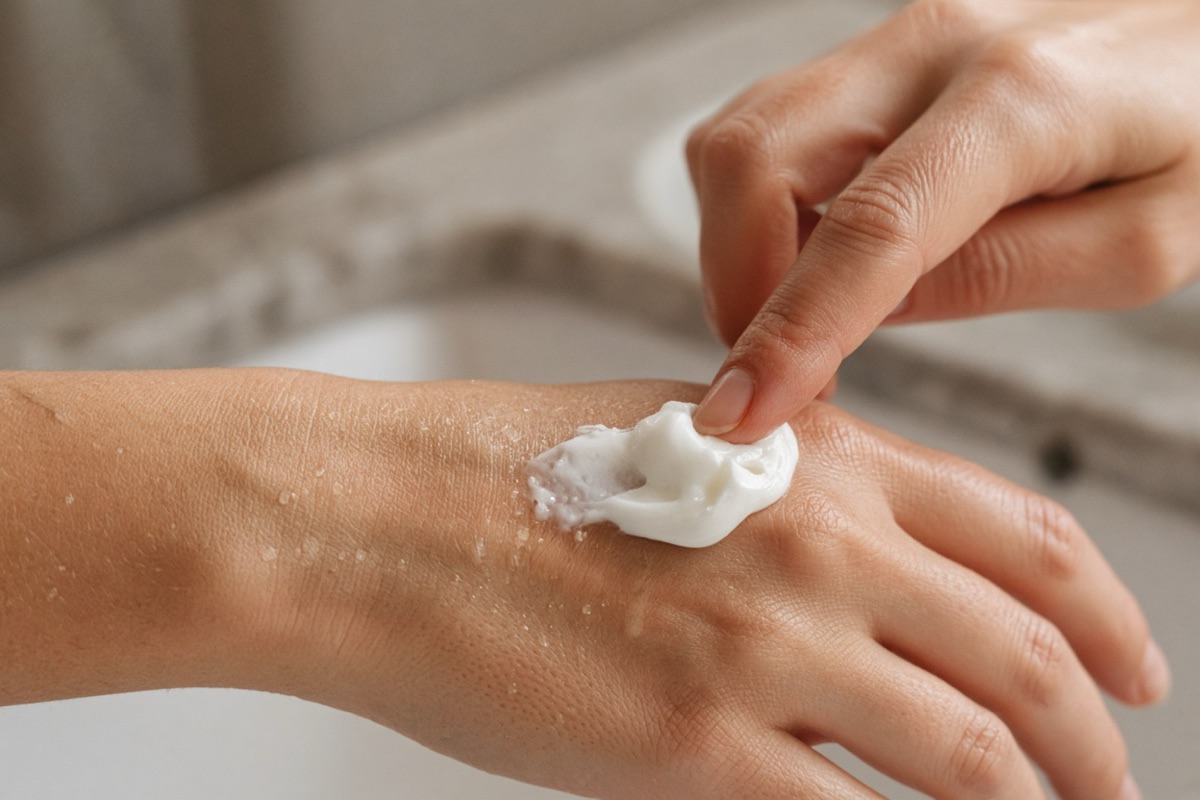
Step 3: Moisturize while your skin is still damp
This is the most important step in any skin care routine for dry skin. The AAD recommends applying moisturizer when your skin is still damp after washing, again after washing your hands, and whenever your skin feels dry.
The AAD also says ointments and creams hold more moisture than lotions. Its list of helpful ingredients includes glycerin, hyaluronic acid, lactic acid, dimethicone, petrolatum, shea butter, jojoba oil, lanolin and mineral oil. The NHS, which calls these products emollients, suggests using them at least three or four times a day.
For the body, a thick cream usually beats a thin lotion. Our page on body lotion for dry skin covers the options.
Step 4: Add a hydrating serum or toner if you like
A serum or toner is optional, not required. If you want one, pick a fragrance-free product with an ingredient from the AAD’s list, such as glycerin or hyaluronic acid, and apply it before your moisturizer.
You can compare ideas in our guides to the best face serum for dry skin and the best toner for dry skin. Patch test any new product on a small area first.
Step 5: Use sunscreen every morning
Sunscreen is the last step of your morning routine. The AAD says to look for a sunscreen labeled “broad spectrum,” “SPF 30 or higher,” and “water resistant.” Apply it after your moisturizer.
Read the label on the AAD guide to selecting a sunscreen if you are not sure what the terms mean.
Step 6: Keep the air in your home from drying you out
The AAD suggests using a portable humidifier in your bedroom while you sleep. Mold can grow in a dirty unit, so the AAD adds that it needs regular cleaning.
Step 7: Protect your hands and keep it simple
Wear gloves for washing dishes and other tasks with lots of water. Moisturize your hands after every wash. Then resist the urge to add more products: the AAD also recommends fragrance-free products, and it points out that “unscented” is not the same as “fragrance-free,” because unscented products can still contain ingredients that cover odors.
What does a morning and evening skin care routine for dry skin look like?
Here is the same plan laid out as a daily checklist. Keep it steady before changing anything, so you can tell what is helping.
| When | What to do | Why |
|---|---|---|
| Morning | Rinse or wash gently, pat dry, apply moisturizer on damp skin, then broad-spectrum sunscreen | Keeps moisture in during the day |
| Evening | Wash gently with warm water, pat dry, optional serum, then a thicker cream or ointment | Replaces what the day removed before sleep |
| Bedroom | Run a clean humidifier at night | The AAD suggests a portable humidifier while you sleep |
| After handwashing | Reapply moisturizer to hands | The AAD advises reapplying after every wash |
| Showers | Five to ten minutes, warm water | The AAD advises five to ten minutes in warm water |
What does a night skin care routine for dry skin add?
At night the focus is repair. Wash off the day, pat dry, and apply a thicker cream or ointment while the skin is damp. Because the AAD says ointments and creams are more moisturizing than lotions, the evening is the best time for the richer product.
Use the humidifier from step 6 as part of your night routine. If you also get dryness in particular spots, these guides may help: dry skin under the eyes and dryness around the mouth.

What should you avoid in a dry skin care routine?
These are the common mistakes that keep dry skin dry:
- Long showers and baths. The AAD recommends warm water and five to ten minutes at most.
- Rubbing the skin dry. Pat instead.
- Waiting until the skin is bone dry to moisturize. Apply moisturizer while the skin is still damp.
- Products with a strong perfume. Choose products labeled “fragrance-free.”
- Skipping hand moisturizer after washing. Reapply every time.
If you use an emollient, note the safety warning from the NHS: keep away from fire, flames and cigarettes, because fabric with emollient on it can catch fire easily.
You can add a weekly extra such as a hydrating mask if you enjoy it, but it is not part of the core routine. See our guide to face masks for dry skin for ideas.
How do you know if your skin care routine for dry skin is working?
Keep the same few products and change one thing at a time, so you can tell what helps. If your skin gets worse after adding a product, stop using it.
A consistent skin care routine for dry skin usually means using moisturizer every day, not only when the skin feels tight. If the dryness persists after you have followed these steps, it may be more than ordinary dry skin.
When should you see a doctor about dry skin?
The AAD advises seeing a dermatologist if dry skin persists after you have followed its recommended strategies, because it can be a sign of an underlying condition such as atopic dermatitis, psoriasis or kidney disease. The NHS suggests speaking to a GP, nurse or pharmacist if you get skin reactions such as burning or stinging, or if you need stronger treatment for a severe condition.
Seek advice sooner rather than later if your skin is cracked, bleeding, very red or painful. Only a doctor can diagnose the cause, and nothing in this article replaces that.
Skin care routine for dry skin: the short version
Wash gently with warm water, pat dry, moisturize while the skin is still damp, wear sunscreen in the morning, add a thicker cream at night, and run a clean humidifier in the bedroom. Keep it simple, change one thing at a time, and see a doctor if your skin does not improve.
Sources: AAD, Dermatologists’ top tips for relieving dry skin (last updated 2 January 2026) and NHS, Emollients (last reviewed 24 October 2023). Both checked 4 October 2026.