

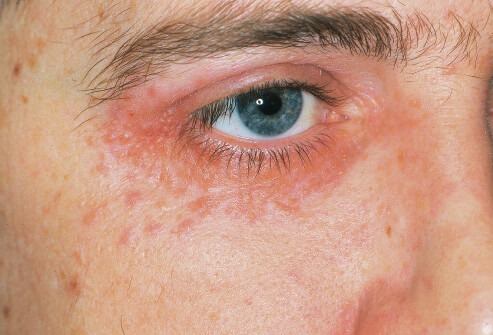
A rash around eyes is often contact dermatitis, which means the skin reacted to an irritant or an allergen. Cleveland Clinic says to see a provider rather than rely on home treatment alone. Helpful steps include stopping new products, avoiding makeup and not rubbing. A rash that involves the eyes themselves needs a doctor.
Last updated 3 October 2026. This article summarizes guidance published by Cleveland Clinic, the American Academy of Dermatology and the NHS. It is not a substitute for advice from your own doctor.
What does a rash around eyes look like?
Cleveland Clinic lists these signs of eyelid dermatitis: a red rash, stinging, scaly skin, burning, swollen skin, pain, itching and blistering. It also calls the condition eyelid eczema.
The NHS describes contact dermatitis more widely as skin that becomes itchy, blistered, dry and cracked. It says reactions usually develop within hours or days, and that it can affect any part of the body but most commonly the hands and face.
What causes a rash around eyes?
Cleveland Clinic says eyelid dermatitis is a type of contact dermatitis. It comes in two forms:
- Irritant contact dermatitis, which the page says makes up about 80% of contact dermatitis cases overall (it gives no separate figure for the eyelids). Triggers include cosmetics, soaps, chemicals and metals, as well as heat, cold and rubbing.
- Allergic contact dermatitis, an immune reaction. Cleveland Clinic names moisturizers, cleansers, aftershave, eye cream, fragrances, latex and nickel in jewelry.
Other conditions can cause a rash on the lids too. Psoriasis can also affect the skin around the eyes, and our guide to psoriasis around the eyes covers it. You can also read more about what causes redness around the eyes.
How do you care for the skin?
Cleveland Clinic is direct on this point. Its page says to see your healthcare provider for eyelid dermatitis instead of trying any at-home treatments. The steps below come from the same sources and are mostly about not making the rash worse.
- Find and avoid the trigger. According to the NHS, the main approach to contact dermatitis is to work out which substance caused it and keep away from it.
- Avoid makeup during treatment. Cleveland Clinic says so directly.
- Choose products made for sensitive skin. This is on Cleveland Clinic’s prevention list.
- Do not rub, and touch the lids with clean hands only. Both are on the same list.
- Use a moisturizer if a provider or pharmacist suggests one. The NHS says emollients (moisturizers) can help when you cannot avoid a trigger. For eczema skin, the AAD suggests a fragrance-free cream or ointment instead of a lotion.
- Test new products first. The AAD’s test is to dab a product onto a patch the size of a quarter, for example on the underside of your arm, each morning and evening for seven to 10 days before you use it more widely.
What treatment can a doctor give?
Cleveland Clinic says providers may prescribe corticosteroids that go on the skin, such as hydrocortisone. They may also use oral corticosteroids or calcineurin inhibitors. The NHS says a pharmacist can help with symptoms and moisturizer choices for contact dermatitis. Your provider can match the treatment to the cause, so ask before you put medicine near your eyes.
When should you see a doctor?
Cleveland Clinic, the AAD and the NHS give these warning signs:
- Emergency care: your eyelids swell so much you cannot see, you have trouble breathing or swallowing, or your eyes or lips swell.
- See a dermatologist: the AAD lists a rash that involves the eyes, lips, mouth or genital skin, a rash that blisters or turns to open sores, a painful rash, a rash that spreads fast, or a rash with fever.
- Infection signs: the AAD names pus, yellow or golden crusts, pain, swelling, warmth or a bad smell.
- Does not clear: the NHS says to see a GP if symptoms are persistent, recurrent or severe. The GP may refer you to a dermatologist if the trigger cannot be identified.
The AAD adds that a rash can take days or even weeks to heal, so ask a dermatologist for a diagnosis rather than guessing.
Related pages on this site cover eczema on the eyelids and care for dry eyelids.
Frequently asked questions
Is a rash around eyes always an allergy?
No. Cleveland Clinic says irritant contact dermatitis makes up about 80% of contact dermatitis cases overall, and the page gives no separate figure for the eyelids. Irritants include cosmetics, soaps, chemicals, metals, heat, cold and rubbing. A provider can help work out which type you have and what set it off.
Can I wear makeup with an eyelid rash?
Cleveland Clinic says to avoid makeup during treatment of eyelid dermatitis. Cosmetics and eye cream also appear on its list of possible triggers. When you do go back to using products, its prevention advice is to choose ones made for sensitive skin, and to ask your provider if you are unsure.
How long does an eyelid rash take to heal?
The AAD says a rash can take days or even weeks to heal, and that most rashes are not life-threatening. Cleveland Clinic says that with treatment, irritant contact dermatitis may start to feel better after one to two days, and allergic contact dermatitis after two to three days. If the rash is not improving, or gets worse, see a doctor soon.
Can the rash reach the eye itself?
Yes, it can, and the AAD lists a rash that involves the eyes as a reason to see a dermatologist. It also says eye problems linked to eczema should be checked when they last more than a few days. According to the NHS, eye pain, vision changes or severe redness need urgent help.
Sources (all checked 3 October 2026)
- Cleveland Clinic, Eyelid Dermatitis, updated 25 October 2021.
- American Academy of Dermatology, Rash 101 in adults: When to seek medical treatment, updated 22 January 2024.
- American Academy of Dermatology, Atopic dermatitis skin care, updated 10 October 2023.
- NHS, Contact dermatitis, reviewed 3 May 2023.
- NHS, Blepharitis, reviewed 12 June 2025.
- American Academy of Dermatology, How to test skin care products, updated 10 August 2021.
- American Academy of Dermatology, Adults with eczema should watch for eye problems, no date shown on the page.
Written by the Dry Skin Tips editorial team. We do not claim medical review of this article. If you have a skin concern, see a qualified health professional.