

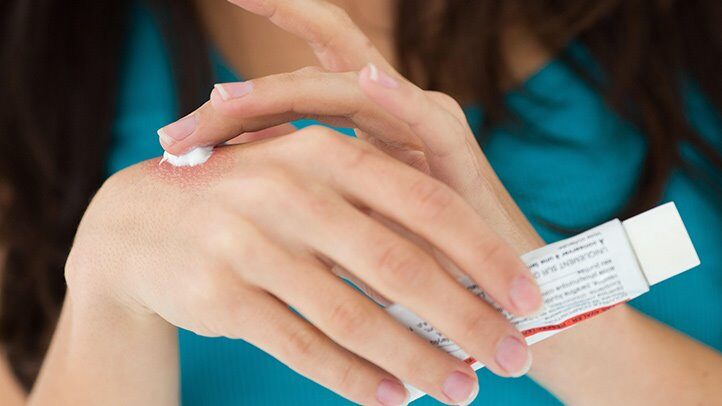
Eczema treatment OTC (over the counter) usually starts with a fragrance-free moisturizer used at least twice a day. Some people add hydrocortisone for itching, for a short time. Store-bought care eases symptoms but does not end eczema for good. If skin does not settle, a doctor can offer prescription options.
Last updated 3 October 2026. This article summarizes guidance from Cleveland Clinic, the NHS and the American Academy of Dermatology. It describes what those groups publish and does not replace advice from your own doctor.
What is the first step in eczema treatment OTC?
Moisturizer. Cleveland Clinic recommends an over-the-counter, fragrance-free moisturizer, in cream or ointment form, at least twice a day for atopic dermatitis (a common type of eczema). It says to choose products without perfumes or dyes and to use them right after a bath or shower.
The American Academy of Dermatology (AAD) agrees on the basics. It says dermatologists recommend moisturizer for everyone with atopic dermatitis. Keeping skin moisturized, it explains, helps prevent cracks that could lead to a worse rash, itching or infection.
Looking for a lotion to use alongside any eczema treatment OTC? Our guides to body lotion for dry skin and hand cream for dry skin cover the dry-skin side.
Can hydrocortisone cream help eczema?
Cleveland Clinic lists over-the-counter anti-itch creams with hydrocortisone as one way to relieve symptoms. The NHS says hydrocortisone is a steroid that treats skin conditions including eczema, psoriasis and contact dermatitis. Most creams and ointments can be bought at shops and pharmacies without a prescription.
The NHS also gives limits:
- Keep hydrocortisone use to a week at most, unless a pharmacist or doctor says otherwise.
- Children under 10 should only use it on medical advice.
- Do not use it on your face, penis or vulva without asking a professional first.
- It is not suitable for some conditions, such as acne, rosacea or cold sores, or on cuts and wounds.
Read the leaflet inside the box and ask a pharmacist if you are unsure.
What other OTC options are there?
Cleveland Clinic names a few more self-care steps for atopic dermatitis:
- Take allergy medicine as directed, if that suits you.
- Add colloidal oatmeal to a bath, as the label directs, to help lock moisture into the skin.
- Use a humidifier.
- Wear comfortable clothing.
- Trim fingernails so scratching does less harm.
It also advises finding and avoiding triggers. Because atopic dermatitis cannot be cleared for good, Cleveland Clinic says, knowing your triggers matters for preventing flare-ups.
What does eczema treatment OTC not do?
It does not replace a diagnosis. The AAD says a board-certified dermatologist can examine the skin and ask about your health history. It says that when medicine applied to the skin is not effective, a dermatologist may prescribe other options such as light therapy or a medicine that works throughout the body.
Prescription treatments exist for those cases. The AAD lists steroid creams and ointments and other prescription creams and ointments that a dermatologist can choose between.
Where can you read more?
Cleveland Clinic’s advice here is for atopic dermatitis, the most common type. Eczema can also affect other places, so see our page on eczema on the eyelids. For oils that people ask about, read argan oil for eczema.
When should you see a doctor about eczema?
Contact a doctor or dermatologist if:
- Skin changes cause pain or discomfort. Cleveland Clinic says to contact a provider in this case.
- Scratching leads to signs of infection: swelling, pain or pus. Cleveland Clinic says to get attention right away.
- Medicine you put on your skin is not helping enough. The AAD says a dermatologist can offer other options.
- You have used hydrocortisone for 7 days and still need it. The NHS says to check with a pharmacist or doctor first.
Frequently asked questions
What is the best OTC treatment for eczema?
No source singles out one top pick. Cleveland Clinic and the AAD both put moisturizer first. Cleveland Clinic suggests a fragrance-free cream or ointment at least twice a day, and lists hydrocortisone anti-itch cream as an option. What suits you depends on the type of eczema, so ask a pharmacist or doctor if unsure.
How long can I use hydrocortisone cream for eczema?
The NHS limits hydrocortisone to 7 days on the skin, unless a pharmacist or doctor advises longer use. If your doctor prescribes it for longer, do not stop suddenly. Follow the leaflet and the advice you were given for your own skin.
Can I put hydrocortisone on my face?
The NHS says not to use it on your face or vulva without talking to a professional first. It also says it is not suitable if you have acne, rosacea or cold sores. Ask a pharmacist or doctor before using any steroid cream on facial skin.
Is an oatmeal bath good for eczema?
Cleveland Clinic lists a colloidal oatmeal bath as a self-care step for atopic dermatitis, to help lock moisture into the skin. Follow the label directions. It is one tip among several and is not a replacement for moisturizer or a doctor’s advice.
Sources (all checked 3 October 2026)
- Cleveland Clinic, Atopic Dermatitis, updated 4 March 2025.
- NHS, Hydrocortisone for skin, last reviewed 28 August 2025.
- American Academy of Dermatology, Atopic dermatitis: diagnosis and treatment, updated 13 July 2026.
Written by the Dry Skin Tips editorial team. We do not claim medical review of this article. If you have a skin concern, see a qualified health professional.